Google

IE8 gains market share at Microsoft's own expense

Gains made by Internet Explorer 8 (IE8) since its launch last Thursday have come at the expense of the older IE7, according to data from Irish metrics firm StatCounter.

And while IE7's market share has fallen by 2.6 percentage points since last Wednesday, the day before Microsoft Corp. released IE8, most rival browsers showed significant gains, giving credence to the idea that Microsoft's newest venture has not pushed users of its competitors to switch.

As of Monday, IE8's market share stood at 2%, an increase of 0.7 of a percentage point since the final code was released. IE7, meanwhile, accounted for 36.9% of the browsers that reached the sites StatCounter monitors for its 2 million users, down from last Wednesday's 39.5%.

Mozilla Corp.'s Firefox 3.0, on the other hand, boosted its market share by 0.5 of a percentage point, to 25.7%, over the same period, while the older Firefox 2.0 grew by 0.05 of a percentage point. Apple Inc.'s Safari 3.2 increased its share by .05 of a percentage point as well since Wednesday, and Google Inc.'s Chrome grew by 0.03 of a percentage point.

Only Opera Software ASA's Opera 9.6 posted a decline in share: The Norwegian-made browser's market share fell by 0.01 percentage point since last Wednesday.

Ironically, it was Microsoft's now-ancient IE6 -- a browser first launched in 2001, prior to the release of Windows XP -- that increased its share the most in the last five days. Since Wednesday, IE6's share climbed 1%; as of today, it accounted for 23.5% of all browsers.

Numbers for IE8 from Aliso Viejo, Calif.-based Net Applications Inc. echo those of StatCounter. As of midday, IE8's market share was 2.1%, up from Friday's 1.9% but down from Saturday's 2.3% and Sunday's 2.5%, according to Net Applications' hourly tracking of the new release.

IE8's fall-off from the weekend is not unexpected. Net Applications has repeatedly noted that browsers not sanctioned in the workplace -- in other words, all but IE6 and IE7 -- typically posts gains on weekends, after work hours and on holidays. The theory is that users, freed from being told what browser they must use at work, turn in larger numbers to Firefox, Safari, Chrome and Opera at those times.

IE8, having just been released in final form, is unlikely to have been approved for use in many business environments.

StatCounter's browser data can be found on its Web site, as can Net Applications' tracking of IE8's market share.
Taken from Computer World
Posting by WELLEN COMPUTER

[...]

DC Tech Arrests Raise Security Issues

After being arrested on bribery charges Thursday, the District of Columbia's top information security official is being held without bail, partly because of uncertainty about whether he still has the ability to access the district's IT systems.

That's just one of many potential security issues facing D.C. government officials after the FBI raided the district's IT offices and arrested Yusuf Acar, its acting chief security officer, and a second man in connection with an alleged bribery scheme.

For instance, Acar had access to personnel data and other confidential information in the district's systems as part of his job. Court documents submitted by the FBI claim that several other district employees were also involved in the bribery scheme. Security analysts warn that Acar and his alleged accomplices could have created backdoors into systems. And since the alleged scheme included misdoings on a purchase of security software, there may be questions about the quality of the district's security tools.

From an IT security standpoint, municipal officials in Washington have a nightmare on their hands, said Johannes Ullrich, chief technology officer at the SANS Institute's Internet Storm Center in Bethesda, Md.

As a security official in the IT department, Acar would have had widespread access to the district's networks and probably also its databases and password files, Ullrich said. In addition, he would have been privy to details about its user-access-control procedures. That level of access and knowledge could have enabled him to do a variety of things, virtually undetected, if he so chose, according to Ullrich.

Without a thorough forensics investigation, there's no telling whether anything nefarious was actually done to the district's systems, Ullrich noted. He said some of the classic rogue-insider actions that D.C. officials should look for include installing backdoors, stealing data and planting logic bombsdesigned to destroy data after a specified period of time has elapsed. Another is tricking other users into installing malware or compromised devices on their systems.

At Acar's arraignment in U.S. District Court Thursday, Assistant U.S. Attorney Thomas Hibarger cited a number of reasons why the IT worker should be held in jail pending a bond hearing scheduled for next Tuesday. First and foremost, Hibarger said there was a "serious risk" that Acar, who has relatives in Turkey, would try to flee the country. But Hibarger also pointed to Acar's broad system-access privileges and said prosecutors didn't know for sure that he would be blocked from accessing the district's network.

Federal investigators haven't said whether they think any of the data in the district's systems was compromised as part of the alleged bribery scheme. A spokesman for the U.S. attorney's office said Friday that he couldn't comment on the investigative steps being taken.

Besides ensuring that Acar is locked out of the network, D.C. officials should also review network and systems logs to check on his activities, Ullrich advised. He also said that passwords and other access-control mechanisms need to be reset and that the district's security tools should be evaluated in light of the FBI's claim that one of the alleged bribery incidents involved a purchase of software from security vendor McAfee Inc.

In that incident, according to the FBI, a Washington-based outsourcing and IT services vendor named Advanced Integrated Technologies Corp. (AITC) bought 500 licenses from McAfee on behalf of the district's IT department but then charged the government for 2,000 licenses. Sushil Bansal, AITC's CEO, was the second person arrested by the FBI in connection with the alleged scheme.

It's possible, Ullrich said, that some of the security technologies bought through AITC aren't best-in-class or the best fit for the district's needs. "There probably are questions about the quality of the [security] infrastructure," he said. "Who knows what they bought? Who knows if they took money for selling access to the network or the data?"

Gartner Inc. analyst John Pescatore called the situation a "huge mess" for D.C. officials. "So far, the major issues that have been raised publicly are financial shenanigans," Pescatore said. But like Ullrich, he said that a major computer forensics effort is going to be needed to find out what else, if anything, the alleged perpetrators may have been up to.

Because AITC also has done work for the district's Department of Motor Vehicles and its human resources office, there potentially was "a lot of opportunity for data snooping or selling of citizen and employee data," Pescatore added.

Alan Paller, the SANS Institute's director of research, said there's also the possibility of security problems resulting from acts of omission on the part of Acar and Bansal. "The main negative here might be that they weren't paying attention to the job but were more interested in lining their pockets," Paller said. But until an investigation is completed, it's impossible to know for sure, he added.

The alleged scheme was complex, according to the charging documents disclosed at the arraignment hearing. Acar submitted purchase orders for higher numbers of products than were actually delivered, resulting in the district being charged for goods it never received, the FBI said in an affidavit. He also added "ghost employees" to the district's payroll and created timesheets for the fictitious workers so payments could be made to them, the FBI claimed.

The bribery case is getting even more attention than it normally would because President Obama last week appointed Vivek Kundra, who until then was the district's chief technology officer, to be the federal government's first-ever CIO.

There were no indications in the court documents that Kundra had any knowledge of the alleged illegal activities. But the White House confirmed Friday that Kundra is taking a leave of absence from the CIO job following Thursday's arrests. That calls into question whether his vision of leading a "technology revolution" at the federal level will ever come to pass.

Taken From PC World

Posting By WELLEN COMPUTER

[...]

Sources confirm Apple laid off salespeople last week

Despite public statements to the contrary, Apple did lay off around 50 enterprise salespeople last week, CNET News has learned.


Sources who wished to remain anonymous for fear of reprisal confirmed reports by Valleywag and 9to5Mac.com that roughly 50 salespeople were let go by the company for "business and economic reasons," according to one source. An entire sales group based in Austin, Texas, was let go as well as workers in Cupertino, Calif., where Apple is headquartered. Those affected were given severance packages and the opportunity to apply for other jobs inside Apple.

Apple spokesman Steve Dowling, when asked Tuesday about Valleywag's report regarding the layoffs in the sales group, declined to comment. An unnamed Apple spokesman then told Silicon Alley Insider on Wednesday that the Valleywag report was not true, the same language Dowling used on Friday in a brief interview with CNET News to describe another report that Apple had laid 50 people off in its Mac Hardware and Pro Applications groups as well as the original report involving the sales group.

Reached on Monday, Dowling declined to comment on the situation beyond the statements provided last week.

However, the layoffs in the sales group did happen, according to several sources who were brought into conference rooms in Austin and Cupertino last Tuesday and given white manila envelopes informing them that they had been laid off, amid plainclothes security officers. It's still not clear whether the Mac Hardware layoffs occurred on Friday.

The seeds for the layoffs began last year, when Apple began de-emphasizing its direct enterprise sales force in favor of a sales strategy that embraced resellers and channel partners as ways of getting its products into the hands of businesses. That shift, believed to come directly from Apple COO Tim Cook, started when former the Apple senior vice president of enterprise sales, Al Shipp, left the company. Shipp, now the CEO of software start-up 3VR, did not return a call seeking comment.

John Brandon, formerly the head of Apple's sales for the Americas resellers like Best Buy and Wal-Mart, assumed control of the group when Shipp left and began making changes. Under Brandon, Apple began to shift away from a sales strategy where representatives built personal relationships with business customers in favor of a channel business that will depend on resellers like Ingram Micro and possibly CompUSA to sell Apple products to business customers.

The decision does not seem to have been prompted by falling sales or poor performance within the group, rather a change in philosophy embraced by Brandon and Cook. But the enterprise group has never been the hot group inside Apple, famous for its consumer retail empire and led by Steve Jobs, a man who disdains much of the entrenched corporate IT mindset.

Apple's shift in its enterprise sales strategy isn't all that remarkable, but Apple's willingness to publicly deny that layoffs took place is another blow to its credibility, already having taken a hit this year over its handling of disclosures involving the health of its CEO, currently on a medical leave of absence until June.

Confirming that a few dozen enterprise salespeople had been laid off as part of a strategic shift--and not a downturn in business--probably would not have made that much of a ripple in the tech media, currently more interested in Apple-related topics such as Netbook rumors and Apple co-founder Steve Wozniak's debut on ABC's "Dancing With the Stars" later on Monday.

Although Apple has been considered one of the more resilient companies in tech after posting strong earnings in January, the continued economic decline is believed to be affecting Mac sales and has prompted some analysts to reduce their expectations for Apple's current quarter. Perhaps the company felt that anything that might be perceived as bad news could hurt its stock price, and since it didn't have to report the layoffs to the Securities and Exchange Commission because they made up a small fraction of Apple's workforce, it didn't have to acknowledge them, period.

Taken from news.cnet.com

Posting by WELLEN COMPUTER

[...]
Amazon's Kindle Secret is in the Software

A year ago I wrote a column titled "E-Book Readers Can Do Better" that outlined what products like the Amazon Kindle and the Sony Reader series would need to add before they truly appealed to mainstream consumers. One year and one tremendous endorsement from Oprah later, Amazon's Kindle 2 incorporates a lot of my suggestions. Still, it isn't the latest Kindle that's cemented Amazon's leadership role in the e-book market. It was today's announcement of a free Kindle reader for the iPhone, because it shows that Amazon really understands what e-books are: software.

As a serious book lover, that's difficult for me to admit. My first edition copy of Ernest Hemingway's Winner Take Nothing is one of my most prized possessions. Seven Pillars of Wisdom, by T.E. Lawrence, complete with its fold-out maps of the Arabian Peninsula, is one of the best things I've read in my life. Carrying my entire book collection up to my fourth-floor walk-up apartment required a fair amount of sweat and even a few tears. Yet despite the vast potential energy of my hundreds of books, their contents would likely fit inside a single Kindle 2. It can, after all, hold 1,500 titles. Good or bad, this is the world we now live in. And Amazon gets it.

Amazon has been wildly successful in the e-book biz. Last year, Kindles literally sold out. But this hasn't kept the company from supplying Kindle for iPhone, a move that's guaranteed to cut into Kindle 2 sales. The thing is, it will also help Amazon sell a lot more e-book titles, and will go a long way toward making Kindle the de facto e-book publishing platform in the U.S. Amazon's not just selling razors, after all—they're also selling the blades. 

The move also indicates that Apple has ceded the e-book market to Amazon. That is probably best, since the iTunes franchise is already stretched thin distributing songs, music videos, TV shows, movies, podcasts, and iPhone apps. "iTunes Store" has become a misnomer; it seems like a name change is overdue. Still, to see Kindle as merely an e-book platform is to miss the forest for the trees. Kindle doesn't just mean books. It is a secure content delivery platform that can be used by every blog, magazine, and newspaper on the Web.

Most of these companies already publish on the Web, but the Kindle platform offers several key advantages. The first, naturally, is DRM protection. Amazon says it is up to content providers to choose or refuse DRM, but so far almost all of the book publishers have chosen to lock up their books. Given what's happened with the music industry, can you blame them? I would love to see a more open format, like ePub, supported by the Kindle, but given Amazon's current success that won't likely happen anytime soon. 

For newspapers, magazines, and blogs, the issue is less DRM than it is fulfillment and subscriber management. As many of you know, PCMag.com recently went 100 percent digital, ceasing to print a paper magazine to focus exclusively on the Web and Zinio digital edition. One of the reasons we partnered with Zinio was so we would have a company that could bill subscribers and manage their accounts. Not many people have managed to do that on the Web, but platforms like the Zinio and Kindle offer a way for readers to get service and for publishers to get paid. 

Before I coronate Amazon as the king of cloud-based content distribution, I'll point out a few places where the company could run aground. One problem revolves around Amazon's dual role as hardware and software vendor. First of all, it could cling too tightly to its closed format. Open-minded publishers like Tim O'Reilly, founder and CEO of O'Reilly Media, have already balked at joining Amazon's single-source, single-file-format delivery system. As the market grows, so will the demand for alternatives. Even Apple supports multiple file formats on the iPod.

Hardware devices like the Kindle are also vulnerable on the price front. $359 is a tough sell in a miserable economy, especially when you can buy a netbook for around same price. A raft of more basic, less-expensive e-book readers are slated to hit the market this year. They won't likely be as easy to use as the Kindle 2 or feature its wireless content delivery, but they'll probably appeal to the cost-conscious consumer who wants to get into electronic books. 

My advice for Amazon is to push the books over the devices—the blades over the razors. The Kindle's competitive advantage isn't in its e-ink display or plastic keyboard, but in the 230,000 titles available at the click of a button. Amazon has become a real software publisher in the truest sense of the phrase.

Taken from pcmag.com

Posting by WELLEN COMPUTER

[...]

Intel introduces Atom chips for new devices

Intel on Monday detailed plans to push its Atom processors into devices beyond just netbooks and mobile Internet devices.

The company introduced four Atom chips that will go into devices such as entertainment systems for cars, videoconferencing devices, robots and interactive kiosks, said Doug Davis, vice president of Intel's digital enterprise group.

These ultra-low-power chips can offer the rich multimedia performance and high-bandwidth Internet connectivity demanded by those devices, Davis said. The Z500-series Atom processors are integrated chips the size of a penny that draw little power and do not require fans to operate. The chips draw 2.5 watts of power or less and run at speeds of between 1.10GHz and 1.6GHz. The chips offer integrated 2D and 3D graphics and will be manufactured using Intel's existing 45-nanometer process. 

Atom chips to date have gone into low-cost laptops, also known as netbooks, and devices such as mobile Internet devices (MIDs) and smartphones. Intel has said it wants to integrate more capabilities into Atom processors that could help the company enter new markets.

With the new chips, Intel is ramping up efforts to dive into an embedded space dominated by chips made with Arm designs, said Nathan Brookwood, principal analyst at Insight64. "Now that they have their Atom processor in good shape, they are looking for new places where they can ship it," Brookwood said.

Some new markets being targeted by Intel with the new chips include entertainment systems in cars and desktop videophones. For example, the new Atom Z520PT powers an in-car infotainment system that can run video without compromising on performance, Davis said. 

Intel and OpenPeak also provided a reference design for a touch-screen videoconferencing phone embedded with a low-power Atom chip. Resembling a blown-up mobile Internet device, the OpenFrame home IP (Internet Protocol) phone design from OpenPeak also runs Internet-based video and social-networking applications, Davis said.

As part of the announcement, Intel also said Microsoft automotive applications would work with Intel's embedded Atom chips. Microsoft's auto division provides a software toolkit for developers to write in-car applic
s that include navigation and hands-free calling.

The new chips will be available in commercial quantities in the second quarter of this year. Pricing information was not immediately available.

Intel has taken a number of steps to develop integrated chips that could fit into devices such as set-top boxes and TVs. The chip maker in February said it was hurrying up the move to the new 32-nanometer process technology to produce faster and more integrated chips. To that effect, the company said it would spend US$7 billion over two years to revamp manufa
cturing plants. The 32-nanometer process will also help Intel make more chips at lower costs and add efficiencies to the production process. Intel will begin producing chips with 32-nm circuitry starting in late 2009.

Intel may also be looking for outside help to develop custom Atom chips for embedded devices. Earlier on Monday, Intel entered a partnership to share the Atom chip designs with Taiwan Semiconductor Manufacturing. TSMC customers will have access to the Atom intellectual property to develop customized chips.

The partnership with TSMC could result in the development of customized chips for Intel to access new markets it can't reach alone, Brookwood said.

If you needed customised GPS (Global Positioning System) or graphics technology on the chip, for example, you couldn't do it, as Intel doesn't provide the building blocks to do so, Brookwood said. The deal with TSMC makes that level of Atom chip customisation possible, he said.

Taken from computernewsme.com
Posted by WELLEN COMPUTER

[...]

Sixty Percent of the World Uses Cell Phones

Six in 10 people on the face of the globe have cell-phone subscriptions, and more than 60 percent of cell-phone users come from developing nations. 

So says a United Nations report published Monday. The report's findings suggest that mobile phones are the communications tool of choice in poor countries. 

The International Telecommunication Union (ITU) reports an estimated 4.1 billion cell-phone subscriptions at the end of 2008. That compares to about one billion just six years ago. Fixed-line subscriptions grew by only one billion since 2002. 

Africa leads the way for developing nations' cell-phone use, with 25 percent of the population toting the devices. 

"There has been a clear shift to mobile cellular technology," the ITU said in its report. It noted that less than half of mobile subscriptions around the world were in developing nations in 2002. 

Faster Access 

In other findings, Internet use has more than doubled. The ITU figures about 23 percent of people globally used the Internet in 2008. That's up 11 percent from 2002. However, despite the double-digit progress, poor countries are still behind on Internet access and adoption. Only one in 20 people in Africa logged onto the Internet in 2007, according to the most recent figures available. 

While some citizens of the planet have yet to sign onto the Internet, more of those who do are using faster speeds. The ITU reports that fixed-broadband use increased to almost 20 percent in richer countries. Still, the statistics for poorer countries reflect the overall Internet usage trend. Broadband Internet access at home is available to only one in 20 people worldwide. 

Mobile broadband subscriptions are climbing the fastest. Mobile broadband technology lets people all over the world log onto the Internet at high speeds. That service is available to three percent of the Earth's population, 14 percent in developed countries. 

Moving Toward a Cashless Society 

The global growth is a boon for handset manufacturers long-term. Although most consumers in developing nations like Africa are not going to invest in iPhones and BlackBerries, the cost of building phones is coming down, making it possible to offer feature phones in developing nations at a profit. 

Some of these countries are starting to use mobile phones for micropayments, according to Mike Disabato, a senior analyst at the Burton Group. Rather than someone in a village in Africa carrying around coins and bills that are subject to theft, he says, they are carrying a mobile phone that transfers digital money back and forth. 

"People in Africa can get paid for the goods that they are selling, they can buy goods this way, and it's actually one step closer to the cashless society. In many respects they are ahead of us in that regard," Disabato said. "If you don't have a vested interest in maintaining folded money or coins in your wallet, why would you want to start?" 

Worldwide Mobile Implications 

Beyond pushing mobile payments to the fore in Third World nations, analysts said these regions of the world may also see GSM coverage sooner rather than later. That could ring the death knell for CDMA networks. Verizon has already signaled that its fourth-generation network would be LTE, which is GSM. That leaves Sprint as the only major carrier running on CDMA. 

"Over time you will end up with a true global handset. Probably by 2020, world-class global phones will be everywhere," Disabato said. "We are kicking out all the old proprietary operating systems, and you are either going to be Windows Mobile, Symbian, Android, Apple or maybe the Palm OS if they survive long enough."

Taken from mobile-tech-today.com

Posted by WELLEN COMPUTER

[...]

Phishers Target Facebook


Facebook users are being urged to be wary of third-party apps after it was revealed hackers have launched another hoax program designed to steal social networker's login details.

Sophos says that the 'F a c e b o o k - closing down!!!' app sends bogus emails to users' contacts, claiming they've been reported "for violating our Terms of Service". The message continues: "This is your official warning! - Click here to find out why you were reported!".


Artwork: Chip Taylor
However, any web user clicking the link will give hackers access to their profile and personal information. Clicking the link also forwards the fake message each user's friends.


"Fans of Facebook will no doubt be aware that the site has been under scrutiny over its terms of service, and these latest attacks are designed to take full advantage of that," said Graham Cluley, senior technology consultant at Sophos.

The warning comes just days after it was reported that a number of users of the social network were downloading the 'Error Check System' program that sent messages to a user's friends claiming they had problems viewing their profile.

"One of the problems is that Facebook allows anybody to write an application, and third-party applications are not vetted before they are made available to the public. So, even as Facebook stamps out one malicious application, another can pop up like a poisoned mushroom with a different name."

Facebook has since removed the application, but there are reports that similar rogue applications with names such as 'My account' and 'Reported For Rule Breaking' are currently circulating on the popular social networking site.
Taken from pcworld.com

[...]

Hackers jump on newest IE7 bug


Attackers are already exploiting a bug in Internet Explorer 7 that Microsoft Corp. patched just last week, security researchers warned today.

Although the attacks are currently in "very, very small numbers," they may be just the forerunner of a larger campaign, said Jamz Yaneza, threat research manager at Trend Micro Inc. "I see this as a proof-of-concept," said Yaneza, who noted that the exploit's payload is extremely straightforward and explained that there has been no attempt to mask it by, say, planting a root kit on the victimized PC at the same time.

"I wouldn't be surprised to see this [exploit] show up in one of those Chinese exploit kits," he added.

The new attack code, which Trend Micro dubbed "XML_Dloadr.a," arrives in a spam message as a malicious file masquerading as a Microsoft Word document. If the fake document is opened, the exploit hijacks PCs that have not been patched with the MS09-002 security update Microsoft issued last Tuesday as part of its eight-patch February batch of fixes.

That update, which plugged two holes in IE7, was rated "critical" by Microsoft at the time.

"We first saw this over the weekend," said Paul Ferguson, an advanced threat researcher at Trend Micro. "But we're not sure if it's just a targeted attack or they're staging for something larger. It's hard to tell at the moment."

It's not unusual for hackers to swing into action with a new exploit only days after Microsoft has patched a previously-unknown vulnerability. "They know it takes users a while to patch," Ferguson added. "Even months after Microsoft patched, the Conficker worm was still able to infect millions of PCs because of lousy patching. That's not lost on the bad guys."

The "Conficker" worm, also known as "Downadup," continues to compromise millions of machines daily, even though, as Ferguson noted, Microsoft patched the vulnerability exploited by the worm nearly four months ago.

Yaneza and Ferguson speculated that the current attacks are precursors to a much larger assault that will revive a campaign that tempted users with news about Tibet. Those attacks, which Trend Micro reported in January 2008, share some characteristics with the newest exploits, including malware disguised as Word documents. Yaneza also said that it appears as though the hacker's command-and-control server is based in China, lending more credence to their theory.

"This is the 50th anniversary of the Tibetan freedom movement," said Ferguson, who said it's likely that a large-scale attack based on this exploit would use that news as bait. In 1959, when the People's Republic of China took full control of Tibet, the Dali Lama fled to India, where he is the head of a Tibetan government-in-exile.

One security expert has called on Microsoft to sever the links between IE and Windows to better protect users from attack. According to Wolfgang Kandek, the chief technology officer at Qualys Inc., people plug IE holes no faster than other critical Microsoft vulnerabilities, something that might change if Microsoft split the browser from the operating system and increased the frequency of its IE patches.

Taken from computerworld.com

[...]

Microsoft unveils Windows Mobile 6.5 OS

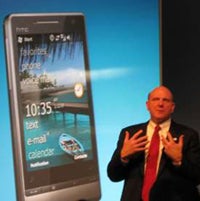
Don't call them Windows Mobile phones anymore. In announcing the latest revision of Microsoft's OS for handsets at Mobile World Congress today, MIcrosoft CEO Steve Ballmer said that henceforth, the devices will be known as Windows phones.


"It's a mouthful to say, 'You want a Windows Mobile phone?'" Ballmer said when asked about the decision to once again re-brand the OS, which has over the years been known as Windows CE and Pocket PC.

Ballmer's three main announcements to a crowd of journalists in Barcelona, Spain, had been widely leaked beforehand: Windows Mobile 6.5, a new version of the handset OS with a revamped, touch-optimized user interface; My Phone, an online backup and sync service for Windows phones, and the Windows Marketplace for Mobile app store.

My Phone and the Windows Marketplace will be accessible to Windows phones running Windows Mobile 6.5; Ballmer said support will be available via download, at the discretion of the vendor, to Windows Mobile 6.1 devices, but not to handsets running earlier versions of the OS.


Windows Mobile 6.5, which in addition to the new user interface sports an improved, more desktop-like browser, will make its debut later this year on handsets also announced on Monday, including the HTC Touch Diamond2 and the LG-GM730.

Interestingly, however, neither handset presents the new user interface unadulterated: Both HTC and LG have made changes they believe make the UI more user friendly. In fact, fiddling with the Windows Mobile UI is not uncommon, and Ballmer squirmed when asked how bothersome this was to Microsoft.

"It's not the area where I would have aspired to see the first add-ons," he admitted. But he said that with the new UI, Microsoft hopes to get more vendors on board without significant changes.
Taken From www.pcworld.com

[...]

Sun 'terrible' place to work


David Axmark, co-founder of MySQL, has quit Sun allegedly because the place is too big.

In his resignation letter, Axmark said he quit Sun Microsystems because he hates all the rules and hates having to break them to come up with anything interesting.

"I have thought about my role at Sun and decided that I am better off in smaller organisations," he wrote.

The letter ended up in Sun watcher Kaj Arnö's blog. Axmark added it would be far better for him to ‘retire’ from employment and work with MySQL and Sun on a less formal basis.

Axmark found himself behind a desk at Sun when the outfit bought MySQL in January for US$1bn.

The other founder of MySQL, Monty Widenius, who was the primary architect of the original database, has also said he wants to walk.

Longtime head of MySQL's Japan business, Larry Stefonic, cleaned out his desk after five years with the outfit.

All up it looks like Sun is about to lose shedloads of MySQL experience because it does not want its workers to use colours that are not on the official list and allow creative people to draw outside the lines.

Taken from www.itnews.com.au

[...]

System upgrade caused Blackberry blackout

A disruption of BlackBerry cellphones in North America for several hours Monday was caused by the failure of one of its recently upgraded systems, Research in Motion said Tuesday.

The Canadian maker of the hugely popular mobile devices that combine telephone, email and Internet capabilities said its preliminary analysis "points to a problem with an internal data routing system within the BlackBerry service infrastructure that had been recently upgraded."
The upgrade was part of RIM's routine and ongoing efforts to increase overall capacity to meet long-term growth in demand, the company said in a statement, noting similar upgrades in the past were problem-free.

"RIM apologizes to its customers for any inconvenience," the company said, adding that no messages were lost during the outage and the system was back up and running normally Monday evening.

Disruption of BlackBerry service is a major bane for business and government employees who rely on the devices to get work done while on the move.

Reliance on BlackBerry "smart phones" is so fierce that they have been jokingly dubbed "CrackBerries" in a reference to a tendency for their owners to compulsively check email as if it were an addiction.
(From Taken www.tech.yahoo.com)

[...]

XO Laptops Go Next to Haiti

The One Laptop Per Child Foundation (OLPC) has teamed up with the Inter-American Development Bank (IDB) to launch a pilot project in Haiti, the first time the group will be able to comprehensively evaluate the idea of giving laptops directly to students as a learning tool.

OLPC, which makes the US$188 XO laptop aimed at kids in developing nations, will contribute $2 million to the project, while IDB will provide a $3 million grant. The project aims to distribute XO laptops to 13,200 students and 500 teachers in 60 Haitian primary schools, the groups said in a statement.

The organizations are financing the project to test whether the use of laptops in schools on a one-to-one basis can improve teaching and learning in Haiti, one of the poorest countries in the world.

"We have studies about the impact of computer labs and shared computers in the classroom, but there's never been a comprehensive evaluation of the learning model based on giving each child a laptop," said Emma Näslund-Hadley, the IDB's project team leader. "This is crucial to determine the effectiveness of this model under conditions of extreme poverty and as a tool for accelerating learning."

Education Aim
One aim of the project is to determine how the laptops can be used to help solve problems such as a shortage of qualified teachers, as well as educating children of different ages and grades in the same classroom. The Haitian government hopes the laptops can help speed up the learning process for students who enter school late or have to repeat grades, according to the release.
Teachers and students will be trained how to use the laptops and carry out basic maintenance and trouble shooting. Some students will receive vocational training to handle more complex laptop repairs.

The project will be evaluated by UNESCO's Regional Office on Education in Latin America and the Caribbean, which will conduct standardized math and language tests before and after the pilot project to determine performance improvements. Observers will also gauge whether the laptops affect attitudes and behaviors regarding school management, the value families place on education, the use of laptops at home, and the perceived educational progress of the students.
Low-Cost Laptops Planned

The OLPC project started as an attempt to build a US$100 laptop and work with governments to pass them out to kids in poor nations, but the XO, will likely end up costing nearly double that amount at first. The organizers of the effort, led by academics and researchers from the Massachusetts Institute of Technology (MIT), hope high-volume sales of the device will drive down costs.

The goal of OLPC is to make sure nobody misses out on the benefits of computing. The fear is that the price of a PC is keeping too many people in developing countries from learning how software, the Internet and communications via computing can improve their economies, job prospects and lives, or that poor countries will fall further behind the modern world due to their inability to access computers.

(Taken From www.tech.yahoo.com)

[...]

Lost Laptop Exposes Nashville Voters to Identity Theft

The theft of a laptop containing Social Security numbers of Nashville, Tennessee, area voters is expected to cost local officials about US$1 million as they roll out identity-theft protection to those affected.

County officials say that thieves broke into Davidson County Election Commission offices on the weekend before Christmas, smashing a window with a rock and then making off with a $3,000 router, a digital camera and a pair of Dell Latitude laptops containing names and Social Security numbers of all 337,000 registered voters in the county.

County election officials began notifying residents of the breach on Jan. 2, and the local government is offering victims one year of free identity theft protection from Debix Identity Protection Network.

Debix says that 25 percent to 35 percent of victims of this type of breach typically request this service. With the city paying Debix just under $10 per account, the price tag for the laptop theft is expected to be in the $1 million range.

Since state data breach disclosure laws went into effect a few years ago, the theft of an unencrypted laptop computer can become a major problem for any organization that stores sensitive data.

"It is a very bad information-handling practice to keep sensitive information about individuals including their Social Security numbers on an unencrypted laptop or any other device that is removable," said Paul Stephens director of policy and advocacy with Privacy Rights Clearinghouse, a privacy advocacy group that has tracked the exposure of 217 million records in the U.S. over the past three years.

Laptop thefts have been the source of privacy breaches at AT&T, The Gap, and the Chicago Public School system recently.

The Metropolitan Government of Nashville and Davidson County's IT services department is now working with the Commission to make changes to protect residents from this type of incident and has already come up with 19 recommendations, said Janel Lacy, a spokeswoman for Nashville Mayor Karl Dean.

(Taken from www.tech.yahoo.com)

[...]

Macworld ranks swell as Apple's 'cool factor' spreads

They come sporting mohawks, full-body tattoos, multiple piercings, and hair in brilliant colors -- the ever-growing congregation of the "Mac-faithful" -- basking in hip technology and declaring love for their iPods, iPhones and everything else from Apple on show at the annual MacWorld Expo.

This year a record more than 50,000 veteran fans and new converts are expected to jam into San Francisco's Moscone Center, on pilgrimages to check out the newest products from Apple Inc.

MacWorld this year is again delivering on Apple's "cool factor," its ability to merge geeky gadgets with youth culture. Apple chief executive Steve Jobs unveiled the company's new iTunes movie rental service and the market's thinnest notebook computer.

And all around the show, which continues through Friday, are the paraphernalia of the Mac cult, books, software and hardware add-ons to take advantage of the dedication of the legions of Apple acolytes.

Their numbers are growing fast: sales of Macintosh computers have outpaced the market due to what analysts refer to as a "halo effect" from Apple's iPod MP3 players and iPhones that combine telephone, Internet, music and video.

"It is pretty much impossible to quantify the halo effect, but we are seeing Apple continue to grow faster than the market, so they are taking market share," NPD analyst Stephen Baker told AFP.

"Clearly, more people are buying Macs and more people are using Macs," he said, noting that people are creating "mixed home environments": running both Windows-based personal computers and Macintosh machines.

On the Macworld floor, Mark Lawrence bought an autographed copy of the book "Switching to a Mac" for his wife to coax her into using her Macintosh instead of her Windows-based personal computer at home.

Lawrence, chief engineer at the Stanford University radio station, is shifting his team to Macintosh computers as well.

"I think the iPod is what got it into people's consciousness that Macs are cool," said Lawrence, a Macintosh devotee for 20 years.

"Apple is doing a great job marketing the cool factor. For me, it has been that they are easy to use and stable."

"I have a friend who got a Mac recently and he actually used the word 'love'," said Philip Goward, founder of the firm Smile On My Mac.

"That's the first time I ever heard someone use that word concerning a computer. I think suddenly we've become cool."

Macworld offerings range from stylishly frivolous to technologically serious.

El Gato hawks an EyeTV device for watching television shows on Macintosh computers, while another company offers its Supacam for streaming video onto the Internet.

Gelaskins offers art print covers for laptops and iPhones, while Otterbox has shock and waterproof containers for iPhones and iPods.

Smithmicro sells a "Poser" program for Macintosh users to make 3-D animated proxies for online virtual worlds, as well as software to create one's own manga or anime characters.

"We look for things that appeal to the Mac market," said Linda Petrucci, head of e-commerce at Smithmicro.

"They are loyal, they stick with us. PC users tend to want something free or at very low cost and then go away."

At Macworld Vestalife launched its Ladybug iPod stereo docking system, designed in collaboration with Element Skateboards, for "teens and 'tweens," children 11 to adult.

"We want to reach a slightly edgy, hip crowd and that fit with Apple," said Vestalife co-founder Wayne Ludlum.

There are even product lines for the Mac-cool hopefuls still nervous about leaving their Microsoft Windows products behind.

VMware is showcasing a Fusion program that enables machines to seamlessly run programs regardless of which operating system they are written for, according to group manager Pat Lee.

"Fusion is a security blanket for those people worried that they will switch to Mac and need that one Windows application they left behind," Lee told AFP. "We are seeing good adoption."

Even Microsoft is at Macworld, the arch-rival launching a Macintosh version of its Office program.

"We blend the best of both worlds: Microsoft technology with Apple's look and feel," said Microsoft's Han-Yi Shaw.

"You get an efficient but esthetically pleasing result we are proud of. We are working very closely with Apple. We succeed together."

(Taken from www.tech.yahoo.com)

[...]

IBM to add software for Apple devices

E-mail software from IBM Corp. will be available on Apple Inc. iPhones and iPod Touch devices under a new partnership that brings together two big rivals of Microsoft Corp.

IBM plans a formal announcement of the Lotus Notes e-mail package for Apple's portable devices at its Lotusphere conference in Orlando, Fla., next week. The software, which requires use of IBM's Domino e-mail server program, will be free for users who already have a Lotus Web-access license and start at $39 per year for new users.

IBM also plans to release Lotus Notes and the free Lotus Symphony "productivity" package — which includes documents, spreadsheets and other Microsoft Office-like software — for Apple's Macintosh computers.

With these moves, IBM is trying to find more avenues for its software and take advantage of Apple's natural affinity for Microsoft alternatives.

The iPhone already can connect users to Web-based e-mail services and to corporate e-mail sent over Microsoft's Exchange e-mail platform, though businesses rarely enable the setting that makes it possible.

If IBM, which counts 135 million Lotus users worldwide, can get companies to let their employees check Lotus e-mail on iPhones, the partnership could make Apple's gadget more competitive with Research in Motion Ltd.'s BlackBerry and other business-targeted smart phones.

IBM and Apple, competitors in the early years of the PC market, traditionally have not worked closely together in software, though Apple used IBM chips in some Macs for several years until ditching them in favor of Intel Corp. processors in 2005. But now the sides appreciate that "we have a lot in common," IBM spokesman Mike Azzi said. "We're going to cross-pollinate."

One reason for the distance between the two companies is the small overlap between Mac users and the big corporate customers that commonly buy products from IBM.

Now, Apple hardware has become a broader platform with the popularity of the iPhone and Web-enabled iPod Touch devices. However, Apple has delayed fully opening the devices to third-party applications; a "software developers' kit" to enable that isn't due until next month. Apple and IBM have been working together on their own.

(Taken from www.tech.yahoo.com)

[...]

Toshiba slashes HD DVD prices after setback

More than a week after being dealt a potentially mortal blow by the defection of Warner Home Video to the Blu-ray Disc camp, HD DVD developer Toshiba is striking back.

The company, left with just two major studios supporting its vision of next-generation technology, said Monday that it is stepping up its marketing campaign to boost the HD DVD format.

But with the centerpiece of this campaign consisting of across-the-board player price cuts -- prices for the two cheapest players are being halved, to $150 and $200 -- observers wonder if Toshiba isn't merely engaging in a fire sale, blowing out its HD DVD machines and pitching them to consumers as a way to get their existing DVD libraries to look better.

Furthering these sentiments are Toshiba's stated goal to spotlight not just the superior benefits of HD DVD but also "the benefits HD DVD brings to a consumer's current DVD library by upconverting standard DVDs via the HDMI (high-definition multimedia interface) output to near-high-definition picture quality."

"It seems like a smart strategy to note that there's value in an HD DVD player even though there is a reduced amount of content available for it," said analyst Tom Adams, president of Adams Media Research. "That's smart both for existing buyers, with whom they have a potential problem, and for purposes of continuing to sell players, where for $150 it's a heck of a DVD player."

Toshiba is slashing the suggested retail price of its entry-level HD-A3 player from $299.99 to $149.99. (This is the same player that was widely available at Wal-Mart and other discount chains just before the holidays for less than $100.)

The midrange HD-A30, with true HD (1080p) output, now retails for $199.99, down from $399.99. And the high-end HD-A35 goes from $499.99 to $299.99.

Yoshi Uchiyama, group vp at Toshiba's digital A/V group, said the company is aiming for the mass market, which he feels is put off by the higher prices for Blu-ray Disc machines ($300 and up).

"While price is one of the consideration elements for the early adopter, it is a deal-breaker for the mainstream consumer," Uchiyama said. "Consumer sales this holiday season have proven that consumer awareness of the HD DVD format has been elevated, and pricing is the most critical determinant in consumer purchase decisions of the next-generation HD DVD technology."

Toshiba also plans an extended advertising campaign involving television, print and online media channels. Also in the works are joint marketing and promotional initiatives with retailers and studios. One such initiative already in play is "The Perfect HD Offer," in which consumers who buy any Toshiba HD DVD player get five free HD DVD movies from a selection of 15.

(Taken from www.tech.yahoo.com)

[...]

Softbank eyes free mobile-IP phone calls: sources

Japan's Softbank Corp (9984.T) is considering offering free calls between its mobile phone and Web-based fixed line phone users to boost its subscriber base, sources close to the matter said on Tuesday.

Softbank has already been offering a similar service on a trial basis in three prefectures in Japan including the northern island of Hokkaido, but nothing has been decided on making it a nationwide service, a company spokesman said.

Softbank is Japan's third-largest cellphone operator behind NTT DoCoMo Inc (9437.T) and KDDI Corp (9433.T). It also offers Internet Protocol (IP) phones as part of its high-speed Internet access service.

The Nikkei business daily said in its Tuesday morning edition the free cellphone-IP phone calls may lower Softbank's per-user revenue, but that the company aims to boost total sales by attracting more customers.

Softbank, which bought Vodafone's (VOD.L) Japan unit in 2006, has outpaced its competitors in netting new users with low-cost price plans and a marketing blitz.

Shares in Softbank were unchanged at 2,070 yen by midday, underperforming the Nikkei average (.N225), which rose 0.5 percent.

(Taken From www.tech.yahoo.com)

[...]

Sprint shows off WiMax devices

With just a few months to go before the launch of its next-generation wireless network, Sprint Nextel Corp. has a distinctly modest lineup of compatible devices.

At the International Consumer Electronics Show here this week, Sprint showed only two computer modems that will definitely be available in April, when its WiMax network becomes available outside current trials in Chicago, Baltimore and Washington.

One of the promises of WiMax, a service Sprint will be providing under the Xohm brand, is that receivers for it can be built into a variety of devices like cameras and Web tablets that usually don't have a built-in Internet connection or rely on Wi-Fi, a short-range technology.

"We fully expect an explosion of consumer devices," said Antone Porter, a product manager at Sprint.

The relative dearth of early WiMax gadgets isn't necessarily a sign of trouble for Sprint. Gemma Tedesco, an analyst at In-Stat, said the coverage area will be relatively small this year anyway, and Sprint's main task will be to build out the network.

"Unlike Wi-Fi, users' satisfaction will be dependent on the network coverage, and so Sprint really needs to have their metro areas well covered, to get users motivated; even this may take time, going into 2009 and beyond," she said.

Unlike Wi-Fi, WiMax signals reach for miles, and unlike cellular broadband, it's designed from the ground up for data. That could make WiMax cheaper than current cellular broadband, or 3G, which often costs around $60 a month for laptops.

Sprint hasn't disclosed pricing plans, but Atish Gude, senior vice president of mobile broadband operations at the company, said he suspects "it will be more affordable than 3G."

At launch, the two devices that will be able to connect to the network are a modem for homes or small-offices from ZyXEL Communications Corp. and a laptop modem from ZTE Corp.

The home modem resembles a huge coffee mug, with two antennas that look like handles. It's intended to make WiMax an alternative to wired broadband provided by phone and cable companies. In addition to providing Internet connectivity, it will have jacks for phone service to be provided over WiMax.

The first gadget to come with built-in WiMax capability may be a new model of the EeePC, a diminutive laptop from ASUSTek Computer. The Taiwanese company started selling a version of the cheap computer without WiMax in the fourth quarter of last year and has sold 350,000 globally, Chief Executive Jonney Shih said.

An Eee with built-in WiMax will be available in the second quarter, Shih said. A price has not been decided. The current Eee uses Linux, a free operating system, but it will be possible to use Microsoft Corp.'s Windows XP on future models, Shih said.

ASUS is also planning to build WiMax into full-size laptops, to be available in the second half of the year, with prices starting at $999.

San Francisco-based OQO Inc. demonstrated at the show a WiMax-equipped prototype of its small handheld Windows computer with slide-out keyboard. But the company did not say when or even if it would be commercially available. OQO already has models compatible with competing cellular broadband networks.

Finland's Nokia Corp., which is supplying Sprint with WiMax network equipment, has said it will build Intel Corp.'s WiMax chips into a Web tablet model in 2008 but hasn't said when.

The backing of Intel means several big-name laptop makers, like Toshiba Corp. and Lenovo, have committed to making WiMax-equipped models, but no details have emerged.

"A lot of times the first year of a technology's rollout is kind of experimental and bumpy — even with the various flavors of Wi-Fi this has happened, and WiMax is much more complicated," said Tedesco, the In-Stat analyst.

Tedesco said the fact that ZyXEL, a "high-volume, low-end networking equipment vendor," is entering the market will push other companies like D-Link, Belkin and Netgear to also make WiMax gear.

(Taken from www.tech.yahoo.com)

[...]

Economic worries mar tech show's glitz

The world's major technology companies are trying to convince consumers they need an expensive, digitally connected home with the latest high-tech gadgets.

But there's a problem: an increasing number of consumers are having trouble just paying for the roof over the heads, much less a 150-inch television.

Few company executives at the annual Consumer Electronics Show in Las Vegas this week can avoid questions about the state of the economy, and the combination of a surge in the U.S. jobless rate, oil around $100 and a worsening credit and housing crisis has many on edge.

"The fourth quarter is full of strange, unanswerable situations related to unemployment, related to GDP, related to everything else," Sony Corp (6758.T) Chief Executive Howard Stringer said on Monday after a briefing at the show. "So it's too soon for us to be pessimistic, but I read the papers."

Electronics retailer Circuit City Stores Inc (CC.N) on Monday became the latest company to undermine the view of some analysts going into the holiday season that U.S. consumers would keep spending on computers, TVs, digital cameras and music players even as the value of their homes declined and foreclosures mounted.

Circuit City, hurt by a costly restructuring, said December sales at stores open at least a year fell more than 11 percent, and it expects to post a fourth-quarter loss.

More critical may be the report of December sales coming Friday from Best Buy Co Inc (BBY.N), the leading U.S. electronics retailer. It is expected to have done significantly better than its rival.

Executives at the show and analysts watching the industry's largest U.S. gathering said they feel confident about the current state of the industry. But they're uncertain about the rest of the year, when some economists expect the United States to slip into recession as the housing crisis worsens.

"We watch very carefully these kinds of general economy issues, and we do feel more and more concerned about the subprime issue and the impact on consumer spending and corporate spending," Jonney Shih, chief executive of Taiwan's Asustek Computer Inc (2357.TW), the largest maker of personal computer motherboards, said in an interview.

"Consumers are under intense pressure," added David Daoud, a personal-computer analyst at market researcher IDC.

"With the price of energy continuing to increase and a lot of people seeing the value of their houses dwindle, it will certainly lead to an amount of tension among consumers," he said. "The question now is, are manufacturers responding to that?"

SLOWING SALES GROWTH

An estimated 140,000 people are expected to descend on Las Vegas this week to check out the latest in consumer electronics. These include wireless Internet devices, a 150-inch plasma TV said to be the world's largest, leather-bound laptop computers and even a robot that cleans gutters.

Before the holidays, technology had been viewed as a safe haven for investors fleeing housing, banking and consumer-discretionary stocks. The Standard & Poor's information-technology index has added 5.6 percent in the past 12 months, beating the S&P 500's 0.5 percent decline and the Dow Jones Industrial's 2.6 percent gain.

But investor sentiment has changed in the past week, after British retailer DSG International Plc (DSGI.L) sent European retail stocks diving when it warned that full-year pretax profit would miss analysts' estimates because of falling desktop computer sales and weaker-than-expected laptop PC demand.

"The market dynamics will definitely change," Oh Dong-jin, president of South Korea's Samsung Electronics Co Ltd (005930.KS), told Reuters in an interview on Monday.

A series of recent analyst downgrades of technology stocks including No. 1 semiconductor maker Intel Corp (INTC.O) contributed to declining confidence in the sector.

The S&P technology index is down 7.7 percent in the past five trading days, making it the S&P's worst performing sector.

While many products at the Las Vegas show may never reach store shelves, collectively they serve to generate consumer enthusiasm for an industry that the show's organizer, the Consumer Electronics Association, expects will generate $171 billion in sales this year.

The amount is a 6.1 percent increase from 2007's total but less than last year's 8.2 percent surge, the group said on Monday.

Besides the technology, "the other overriding issue of focus is the state of the global economy, as CES serves as a crossroads for large companies from multiple geographies," Bear Stearns analyst Andrew Neff wrote in a note to investors. "Visibility remains limited."

Fears of a deteriorating U.S. economy and falling DVD sales helped drive Warner Bros' decision on Friday to exclusively back Sony Corp's (6758.T) Blu-ray next-generation DVD format, in a blow to Toshiba Corp's(6502.T) rival HD DVD format, a top studio executive told Reuters on Monday.

"We've typically been recession-proof," Warner Bros Entertainment Group President Kevin Tsujihara said at the Las Vegas show. "But the thing we saw in the fourth quarter ... was gas prices beginning to affect sales. And since we're considered an impulse purchase, it's beginning to impact us."

(Taken from www.tech.yahoo.com)

[...]

Intel banks on another wireless gadget

Intel Corp. is betting on a big expansion of "ultra-mobile" computing, an idea that could hinge on how many gadgets people are willing to tote around.

In an interview Monday at the International Consumer Electronics Show, Intel CEO Paul Otellini said energy-efficient, Web-connected computers with full keyboards and screens in the 4-inch neighborhood can give people more of what they want from the Internet than cell phones can.

To help stimulate the technology, Intel plans in the next few months to begin shipping processors and associated "chipsets" that demand relatively little power and are smaller than standard PC processors, allowing them to be crammed into tinier devices, which would be built by other companies.

Eyeing a similar market, wireless chip maker Qualcomm Inc. also has built prototypes of little Web devices. Its chief operating officer, Sanjay Jha, said he expects manufacturers to take up the blueprints and begin selling what he calls "pocketable computers" by the end of this year.

So far, so-called ultra-mobile computers, smaller than average laptops but bigger and more fully featured than most cell phones, have gotten a tepid response.

With the devices' prices often beyond $1,000, many potential buyers have found little reason to scale down from their notebook computers or up from cell phones that have been improving their Web browsing experience.

"How do you make people realize that this is something advantageous to them and different from the notebook experience?" said Richard Shim, an analyst with IDC, a market research firm. "That's the trick. Nobody's been very good at that yet. ... It's not as widely compelling as it needs to be if they want it to compete on the level of a phone or a PC."

But Otellini said such distinctions will cease to matter, especially since small Web devices can incorporate cell phone functions. And he said Apple Inc.'s iPhone showed that combination devices can be elegant.

"You're projecting an end stage on an early technology," he said. "That's a risky thing to do."

To be sure, even with cell phones in nearly every pocket or purse, another gadget could be appealing if it does something particularly compelling. For example, more and more cell phones play music, but plenty of people also carry MP3 players that do the job better.

In a keynote speech Monday at CES, Otellini tried to show that ultra-mobile PCs — he prefers the name "mobile Internet devices" to better distinguish them from laptops — offer a new kind of information-on-the-go bliss.

He demonstrated how an American traveler to Beijing might use a pocket computer to get real-time navigation tips and instant translations of signs, menus and conversation from Chinese.

Otellini acknowledged that this vision for ultra-mobile computing might not be fully realized for a few years.

For one thing, little PCs need longer battery lives so people can tote them around and use them all day.

Intel also expects that wireless broadband networks based on the WiMax standard will develop much further to enable connectivity on the devices. But Otellini said the computers could also make use of cellular networks.

That is the connectivity route favored by Qualcomm, which is a major supplier to the wireless industry. Jha, the Qualcomm executive, said wireless carriers first will need to come up with more enticing data pricing plans.

Proof that wireless carriers will be crucial is in the weak reception for Sony Corp.'s Mylo handheld messaging device. Though it has a full keyboard and sells for around $300, it can go online only in Wi-Fi hot spots, which have limited range.

This is far from the first time Intel has ranged beyond its specialty in PC and server chips in an attempt to diversify — and take the edge off the up-and-down cycles common in the chip business. Past forays that hit dead ends include chips for music players, TVs and cell phones. Intel once even tried selling toy microscopes.

These days, some analysts fear Intel's inventory for PC chips is backing up because of slowing orders from the industry. Intel's shares fell 15 percent last week, vaporizing about $24 billion in shareholder wealth.

Intel also is eyeing home entertainment devices. Otellini introduced a computing-and-graphics-microprocessor combo that can run TVs and set-top boxes.

The company's goal with that product, called Canmore and due out late this year, is to make it easier for people to move Internet content to high-definition TVs.

Otellini said neither that nor the mobile Internet device venture is a mere side project.

"We don't make small bets on anything," he said.

(Taken from www.tech.yahoo.com)

[...]